
Portable air conditioner buying guide
By Kyle Marshall Rance. Updated .
This guide is for anyone trying to cool a room in the UK without the cost, complexity, or planning permission of a split-system installation. We cover how portable ACs actually work, why a real one is always vented, how to size one correctly, the single-hose versus dual-hose debate, the thorny business of venting through UK windows, running costs, and noise, so you can buy with confidence rather than returns.
How they actually work
A portable air conditioner works on the same refrigerant cycle as a fridge or a wall-mounted split system. A compressor pressurises refrigerant, which releases heat as it condenses; that heat is expelled through an exhaust hose to the outside. On the indoor side, refrigerant evaporates across a heat exchanger coil, absorbing heat from the room air blown over it. The cooled air is returned to the room. Because the compressor and condenser both sit inside the unit rather than outdoors, some of their waste heat stays in the room. This is the fundamental efficiency disadvantage compared to a split system.
Condensate, the water drawn out of the air as it cools, has to go somewhere. Older units need a drain bucket emptied every few hours. Most current portable ACs are self-evaporative in cooling mode: they spray condensate over the condenser coil so it evaporates and exits via the exhaust hose along with the hot air. In very humid conditions or when running in dehumidify mode, the self-evaporative system can be overwhelmed and a drain hose or tray will fill up. Check whether your model includes a full-tank alert.
Vented vs ventless: is it a real air conditioner?
Every genuine portable air conditioner is vented. The refrigerant cycle moves heat out of your room, and that heat has to leave the building somehow, so the unit pushes it outside through an exhaust hose (typically 130 to 150 mm wide) fitted to a window or wall. If there is no hose to the outside, the heat has nowhere to go and the room cannot get cooler overall.
Products sold as "ventless", "no hose needed" or "portable air cooler" are almost always evaporative coolers. They blow air across a wet pad or through a water tank. The evaporating water makes the air coming out feel a few degrees cooler if you sit right in front of it, but they remove no heat from the room and they add moisture to the air. In a humid UK heatwave, when the air is already damp, that trade gets worse: the cooling effect shrinks and the room feels muggier. They cost a fraction of a real air conditioner, which is why they sit next to them in search results and listings.
Quick ways to tell them apart on a product page:
- A real air conditioner lists a BTU rating, a refrigerant (usually R290), a compressor, and a window kit or exhaust hose in the box. Expect 25 to 35 kg and a price of roughly £200 upwards.
- An evaporative cooler lists a water tank capacity, ice packs or a "cooling pad", no BTU rating, and no hose. It usually weighs under 10 kg.
A third category sits in between: through-wall monoblock units (sometimes sold as "air conditioners without an outdoor unit"). They have no hose because they vent through two holes drilled in an outside wall. They are still vented, just permanently, and they need installing.
Everything we track on AirconDrop is a vented, refrigerant-based portable air conditioner. We deliberately filter out evaporative coolers, fans and "mini air coolers" so the alerts you get are for units that will actually cool a room.
Sizing for your room (BTU)
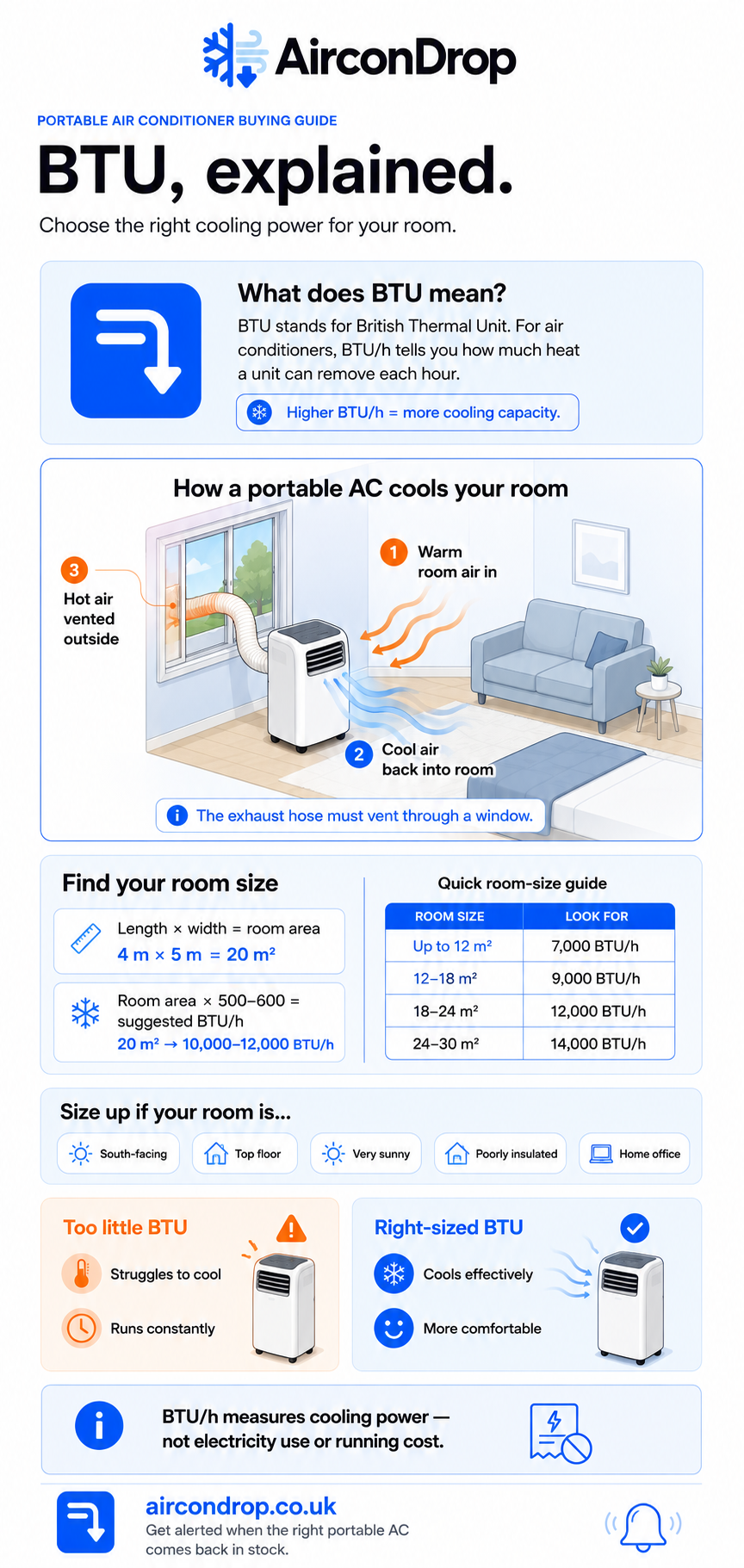
The standard starting point is roughly 100 BTU per square metre for a typical UK room with average ceiling height (2.4 m), average insulation, and north- or east-facing windows. That rule of thumb gets you into the right ballpark, but the adjustments below matter more than the base number, especially in older UK housing stock where insulation is poor and solar gain through single-glazed windows is significant.
BTU calculator
Pick a room type, or enter square metres. Add any extras that apply.
Recommended
5,000 BTU
Based on 18 m² with your extras. Raw estimate 1,800 BTU, rounded up to the nearest standard size sold in the UK.
Uplifts to add: south- or west-facing windows typically warrant around +20%; a kitchen adds roughly +30% due to cooking heat; each additional occupant beyond two people adds approximately 600 BTU; a top floor with a flat or poorly insulated roof adds around +10%. These are commonly used rules of thumb. Your actual room will vary.
Avoid the temptation to over-size. A unit that is too large will reach the set temperature quickly and switch off before it has had time to dehumidify the air properly, leaving the room feeling clammy. An undersized unit will simply run continuously without ever bringing the temperature down to the target, wasting electricity and wearing out the compressor. Getting the BTU broadly right is the single most impactful purchase decision you will make.
Single-hose vs dual-hose
A single-hose portable AC expels hot air through one hose to the outside. As it pushes air out, it has to draw replacement air in from somewhere, and in most UK homes that means pulling air in through door gaps, letterboxes, window seals, and any other infiltration point in the building envelope. That makeup air is warm outdoor air, which the unit then has to cool again. The result is a mild negative pressure inside the room, reduced efficiency, and a unit that is effectively fighting itself in leaky Victorian terrace houses (which describes a large portion of the UK housing stock).
A dual-hose unit uses one hose to draw outdoor air directly for cooling the condenser, and a second hose to expel the resulting hot air outside. Because the outdoor air never enters the living space, there is no negative-pressure problem and no makeup-air penalty. In practice, dual-hose units are typically more efficient in leaky buildings, cool the room faster, and are better suited to larger spaces. The trade-off is that they are noisier, heavier, and harder to find in the UK market, and they cost more. Our honest recommendation: a dual-hose unit is worth seeking out only if you are trying to cool a room larger than 20 m², you can achieve a properly sealed vent setup for both hoses, and the budget allows. For most UK bedrooms and home offices, a well-specified single-hose unit will do the job adequately.
Venting through UK windows
This is where most UK portable AC installations go wrong. Nearly every unit ships with a flat sliding-window vent kit that slots into the channel of a horizontal-sliding window. UK homes have a wide variety of window types, and most of them are not horizontal-sliding windows.
Sash windows
Traditional sash windows, the kind that slide vertically and are ubiquitous in London and Victorian housing stock across the country, are the hardest to vent through. The standard kit will not fit. You will need either a sash-window-specific adapter kit (sold by some specialist retailers), or a custom panel cut from perspex or 6 mm plywood to fit the open lower sash, with a hole for the hose diameter (typically 130–150 mm). Sealing around the edges with self-adhesive foam tape keeps the warm outside air from flowing back in around the panel.
Sliding windows
Horizontal sliding windows are the easiest. Standard vent kits almost always fit. Measure the height of the opening before buying a kit. Some kits only extend to 120 cm and some UK sliding windows are taller.
Casement (side-hinged) windows
Side-hinged casement windows need either a casement-specific vent kit or a custom panel. Holding the window open to a fixed angle with a panel wedged into the gap works reasonably well for ground-floor rooms; for upper floors, securing the panel firmly is important.
Tilt/turn windows
Common in newer flats and purpose-built housing. The tilt position, where the top of the window tilts inward, gives you a narrow horizontal gap at the top, which can be sealed with a panel and hose. The turn position, where the window opens fully inward like a door, leaves a large perimeter gap around the hose that is very difficult to seal, and is not suitable for AC venting without a custom frame.
General venting tips
Hose length matters. Most units ship with a hose of around 1.5 m. Longer hose runs reduce efficiency because the hose itself radiates heat back into the room; keep the path as short and straight as possible. Where the hose bends, keep bends gentle. Sharp bends restrict airflow and increase back-pressure on the compressor.
Seal the gaps. A poorly sealed vent kit lets warm air back in around the hose, partially negating the cooling. Self-adhesive foam draught-exclusion tape (widely available from DIY retailers) is inexpensive and effective for filling the gap between the vent panel and the window frame.
Do not let the hose sag. A sagging hose creates a low point where condensate can pool. If the unit is self-evaporative, that pooled condensate may drip back into the room or back into the unit. Route the hose to slope gently upward or level from the unit to the vent.
Noise (dB). What to expect
Portable ACs are not quiet appliances. The compressor, condenser fan, and evaporator fan all run simultaneously, and they are all in the room with you. As a rough orientation: units that measure below 50 dB on their low fan speed are typically tolerable in a bedroom for sleeping. That is roughly the level of a quiet office or a quiet conversation in the next room. Units in the 50–60 dB range are acceptable in living rooms where some background noise is expected. Units above 60 dB are best reserved for kitchen or utility-room use where noise is less of a concern.
One important caveat: manufacturers almost always lead with the low-fan-speed noise figure in marketing materials. A unit advertised as "43 dB" may be 52 dB on its highest fan speed, which is the speed you need when the room is genuinely hot. Read the full specification datasheet rather than the headline marketing figure, and look for a unit with separate noise ratings published for each fan speed.
Running cost. What you'll actually pay
The formula is straightforward: power draw in kilowatts multiplied by hours of use per day, multiplied by your electricity unit rate, gives you the daily cost in pounds.
As a worked example: a 1.0 kW unit run for 6 hours per day at £0.245 per kWh costs approximately £1.47 per day. Run every day across a typical UK summer month that is around £44 per month.
Energy efficiency ratings (A through D on the scale used in UK product listings) make a measurable difference over the season. An A-rated 12,000 BTU unit typically draws around 1.1 kW under load; a D-rated unit of the same nominal BTU may draw closer to 1.4 kW. On a 6-hour-a-day pattern that 300 W difference costs roughly £0.44 extra per day, around £13 over 30 days. Actual draw varies with ambient conditions and thermostat setting.
If your unit has a built-in timer or runs on a smart plug, use it. Precooling the room for an hour before you need it, then switching off, is typically more cost-effective than running continuously.
What we recommend right now
The four units below are our current picks. Where a retailer feed carries them, they are also in our restock-alert tracking. We are not paid to feature any of them; some links are affiliate links (see our affiliate disclosure).
MeacoCool MC Series Pro 9000 CH. Best for small bedrooms and home offices up to around 15–16 m². The built-in heater means it doubles as a room heater in winter, which improves the cost justification significantly. View at Meaco
MeacoCool MC Series Pro 10000 CH. The sweet spot for a typical UK double bedroom. Slightly more headroom than the 9000 CH for warmer days or a less-than-perfect vent setup, with the same heater functionality. View at Meaco
Meaco Cirro 12000 BTU (Cooling Only). The flagship quiet-mode pick for living rooms and open studios up to around 25 m². Meaco publishes noise figures across all fan speeds and the low-speed figures are among the lowest in the class. Cooling only, no heater. View at Meaco
Honeywell HX07CESAWG 7,000 BTU. A budget-accessible option for smaller rooms with three operating modes: cooling, dehumidify, and fan only. Useful if you want dehumidify capability as a standalone function during damp UK shoulder seasons. View at Aircon Centre
Picks reflect current stock tracking, not commercial partnerships. If a unit goes out of stock or a better option appears, we update accordingly.
Also browse portable air conditioners on Amazon →
How we put this guide together
Sizing, noise and power figures come from manufacturers' published specifications and the UK retailer listings we track. The BTU rule of thumb is a starting point for typical UK rooms, not a survey of your home. Running costs assume about 25p per kWh, a round figure close to typical UK unit rates, so scale them to your own tariff. We have not lab-tested every model. Written by Kyle Marshall Rance. Spotted something out of date? Email hello@aircondrop.co.uk.
Quick FAQ
Is there a portable air conditioner that doesn't need venting?
No. Any unit that genuinely cools a room with a refrigerant compressor has to vent its heat outside, so it will come with an exhaust hose. "Ventless" portable units are evaporative air coolers, which feel cool up close but do not lower the temperature of the room. See vented vs ventless above.
Do I need to drain water?
Most modern portable ACs are self-evaporative in cooling mode. They use condensate water to help cool the condenser, so it evaporates and exits through the exhaust hose rather than filling a tank. You typically only need to drain in dehumidify mode, or when ambient humidity is very high and the self-evaporative system cannot keep up. Your model's manual will specify the conditions under which the tank will fill. Most units have a full-tank indicator light or audible alert that switches the unit off automatically.
Can I leave it running while I am out?
Not recommended for full-day unattended use. Modern units include over-temperature cutoffs, but running any electrical appliance unattended for hours carries some risk. More practically, it is inefficient: the room warms up again after the unit cycles off anyway. Use the built-in timer or a smart plug to start cooling an hour before you return rather than running it all day.
Will it heat the room next door?
No. The hot air goes out through the exhaust hose, not into the adjacent room. Some heat transfers through the wall behind the compressor (the unit's casing will feel warm), but the quantity involved is not enough to noticeably affect an adjacent room under normal conditions. The net effect on the overall building is that you are moving heat from one room to outdoors.
Do portable ACs work in flats without proper windows?
Only where there is a real vent path to the outside. A tilt-only window with a well-sealed custom panel works. A vent brick with the right diameter adapter fitting can work in some cases. A skylight or roof light with a suitable panel is also possible, though heat rises and a top-vent may be less efficient. What will not work is venting into a cupboard, a void, or another internal room. You are simply moving the heat somewhere else in the building. Without a genuine route to outside, a portable AC just heats the building.